
The Chandigarh Tricity region — encompassing Chandigarh, Mohali, Panchkula, Zirakpur, and Kharar — is on the verge of a major infrastructure transformation. The proposed Mass Rapid Transit System (MRTS), commonly referred to as the Tricity Metro, is a project that could fundamentally reshape how people live, commute, and invest in this rapidly growing corridor of North India.
For real estate investors and homebuyers, the metro project represents a rare early-mover opportunity. History shows that metro connectivity consistently drives property price appreciation in Indian cities — Delhi, Bangalore, Hyderabad, and Pune have all seen 20–40% price jumps near metro corridors within 3–5 years of operations beginning. The Tricity is next.
What Is the Chandigarh Tricity Metro Project?
The Tricity Metro is a proposed mass rapid transit system designed to connect Chandigarh, Mohali, Panchkula, Zirakpur, and surrounding areas through a network of elevated and underground metro lines. The project has been under discussion for over a decade, but recent developments have accelerated its progress significantly.
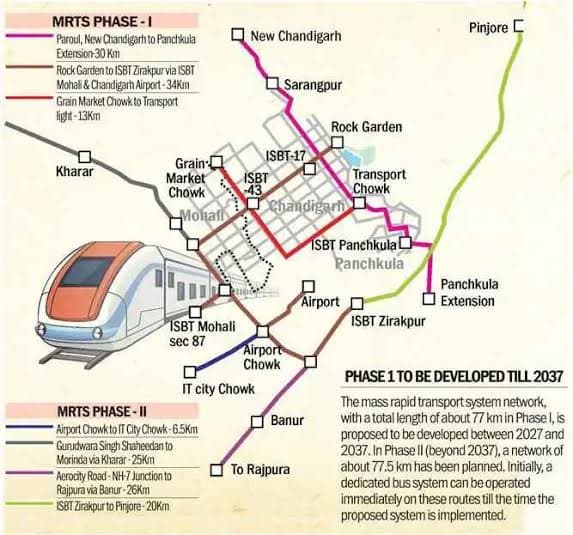
In Phase I, the network will cover approximately 77 km across three main corridors. The first corridor runs from Paroul in New Chandigarh to Panchkula Extension, covering 30 km. The second corridor connects Rock Garden to ISBT Zirakpur via ISBT Mohali and Chandigarh Airport, spanning 34 km. The third corridor links Grain Market Chowk to Transport Light, covering 13 km. Phase I is proposed to be developed between 2027 and 2037.
Phase II, planned for beyond 2037, will add approximately 77.5 km more with corridors connecting Airport Chowk to IT City Chowk, Gurdwara Singh Shaheedan to Morinda via Kharar, Aerocity Road to Rajpura via Banur, and ISBT Zirakpur to Pinjore.
Key Stations and Corridors That Matter for Real Estate
Not all metro stations will have the same impact on property values. The stations that matter most for real estate are those at intersection points, near commercial hubs, or in areas with significant development potential. Here are the key corridors and stations to watch:
ISBT Mohali (Sector 87) — This station sits in one of Mohali’s most actively developing residential zones. Sectors 66–80 and beyond are already seeing premium residential projects. Metro connectivity here will accelerate demand and price growth significantly.
Airport Chowk — Located near Chandigarh International Airport, this station will serve as a critical interchange. Properties within 1–2 km of this station are likely to see the highest appreciation due to dual airport and metro connectivity.
IT City Chowk — Mohali’s IT hub is already a magnet for working professionals. Adding metro access will make this area even more attractive for both residential buyers and commercial investors.
ISBT Zirakpur — Zirakpur is one of the Tricity’s fastest-growing residential markets. A metro station at ISBT Zirakpur will provide direct connectivity to Chandigarh and Panchkula, significantly boosting property demand in the PR7 Road and Patiala Highway corridors.
Rock Garden / Sector 17 — The heart of Chandigarh. Metro access to these central locations will increase the premium on properties in surrounding sectors and improve rental yields for investor-owned apartments.
New Chandigarh (Mullanpur) — This planned satellite city is positioned as the next major residential hub. The metro’s Phase I terminus at Paroul/New Chandigarh will validate the area’s long-term growth potential.
How Metro Connectivity Impacts Property Prices: Evidence from Indian Cities
The relationship between metro connectivity and property prices is well documented across Indian cities. Here is what the data shows:
Delhi NCR — Properties within 500 metres of metro stations in Delhi saw 25–35% higher appreciation compared to properties located 2+ km away. Areas like Dwarka, Noida Sector 62, and Rajiv Chowk experienced dramatic price increases after metro operations began.
Bangalore — The Namma Metro corridors in Bangalore triggered 30–40% price appreciation in areas like Whitefield, Electronic City, and Majestic. Even the announcement of metro extensions boosted property demand in previously overlooked suburbs.
Hyderabad — After the Hyderabad Metro became operational, residential property prices along the Miyapur–LB Nagar corridor increased by 20–30% within 3 years. Commercial rents near metro stations increased even more significantly.
The pattern is clear: metro connectivity creates a permanent infrastructure advantage that translates directly into property value. The Chandigarh Tricity region, with its already strong fundamentals, is positioned to see similar or even stronger effects.
Which Areas Near the Proposed Metro Could See the Highest Appreciation?
Based on the proposed route map and current market conditions, these areas are most likely to benefit from the metro project:
Mohali Sectors 66–80 and Sector 87 — Already a premium residential zone with projects priced between ₹80 lakh and ₹2.5 crore. Metro access from ISBT Mohali will push prices higher. Properties here are currently available at pre-metro pricing, making this one of the best early-investment zones.
Zirakpur (PR7 Road and Patiala Highway) — Zirakpur’s residential market has grown rapidly over the past 5 years. The ISBT Zirakpur metro station will transform the area from a road-dependent suburb into a metro-connected urban centre. Expect 15–25% price appreciation within 3–5 years of metro operations.
Aerocity and IT City Mohali — These commercial hubs will benefit from improved workforce connectivity. As more IT professionals gain metro access, demand for rental apartments and owner-occupied homes in surrounding sectors will increase.
New Chandigarh (Mullanpur) — Currently priced 30–40% below comparable properties in established Chandigarh sectors. The metro terminus here will validate the area’s development potential and narrow the price gap over the next decade.
Panchkula Extension and Pinjore Corridor — Phase II metro connectivity to Pinjore will open up affordable investment opportunities in areas that are currently undervalued due to limited public transport options.
Timeline and Current Status of the Project
The Tricity Metro project has made progress in recent years. A Detailed Project Report (DPR) has been prepared, and the project has received attention from both the Punjab and Haryana state governments as well as the Chandigarh UT administration. The central government’s push for urban mobility through initiatives like the National Urban Transport Policy and Smart Cities Mission provides additional momentum.
Phase I is targeted for development between 2027 and 2037. Initially, a dedicated bus system may operate on the proposed metro routes until the full rail system is implemented. This phased approach means that even before metro trains start running, the corridor alignment and station locations will begin influencing property markets.
For investors, the key insight is this: the biggest price gains typically happen between project announcement and project completion. By the time a metro line is operational, most of the appreciation has already been priced in. The current pre-construction phase offers the best risk-reward ratio for property investment.

Investment Strategy: How to Position Yourself
If you are considering investing in property near the proposed metro corridors, here is a practical framework:
Focus on properties within 1 km of proposed stations — Research from Indian metros shows that the strongest appreciation occurs within a 500-metre to 1-km radius of metro stations. Properties beyond 2 km see diminishing metro-related premiums.
Prioritise ready-to-move or near-completion projects — Given that the metro itself is years away from completion, buying in established or nearly complete projects gives you rental income while you wait for metro-driven appreciation.
Look at both residential and commercial — Metro stations drive foot traffic, which benefits retail and commercial properties. Mixed-use developments near proposed stations offer diversified investment potential.
Consider the long-term hold — Metro-driven appreciation is a 5–10 year play, not a quick flip. The strongest returns go to investors who buy early and hold through the construction and early operations phase.
What This Means for Homebuyers
For homebuyers looking to live in the Tricity, metro connectivity adds a quality-of-life dimension that goes beyond investment returns. Shorter commutes, reduced dependence on personal vehicles, lower transportation costs, and better access to commercial and entertainment hubs are all benefits that improve daily living.
Families with school-going children, working professionals commuting across the Tricity, and senior citizens who rely on public transport will all benefit significantly from metro connectivity. Buying a home near a proposed metro station today means securing these lifestyle benefits at pre-metro prices.
RedStar Huts: Your Metro Corridor Investment Partner
At RedStar Huts, we have been closely tracking the Tricity Metro project and its potential impact on property markets across Mohali, Zirakpur, Chandigarh, and surrounding areas. Our advisory team specialises in identifying high-potential investment opportunities along infrastructure corridors.
We currently have curated listings in key metro-adjacent locations including premium flats in Mohali Sectors 66–80, luxury apartments on PR7 Road Zirakpur, IGBC certified residences near IT City Mohali, and ready-to-move smart home projects on Zirakpur-Patiala Highway. Each of these properties is positioned to benefit from improved metro connectivity in the coming years.
Schedule a free consultation with our team to discuss how the Tricity Metro project could shape your property investment strategy. Call us at +91 889 434 3056 or visit our contact page to get started.